


Summary:
- Ecuador has descended further into violence, with President Noboa declaring an internal armed conflict in 2024 and criminal gangs expanding their reach across the country.
- International actors are increasingly becoming involved in the response to Ecuadorian gang activity. As part of this, the US has expanded its intervention, which centers around the diplomatic, financial, judicial and military realms. Measures include bilateral agreements around intelligence sharing, sanctions and provision of equipment to the Ecuadorian military.
- The US’ involvement in Ecuador fits into a broader regional strategy to combat narco-trafficking activity in Latin America. The extent to which this approach will be successful remains to be seen, but the escalation of the security situation in Ecuador makes the US’ presence likely to continue for the foreseeable future.
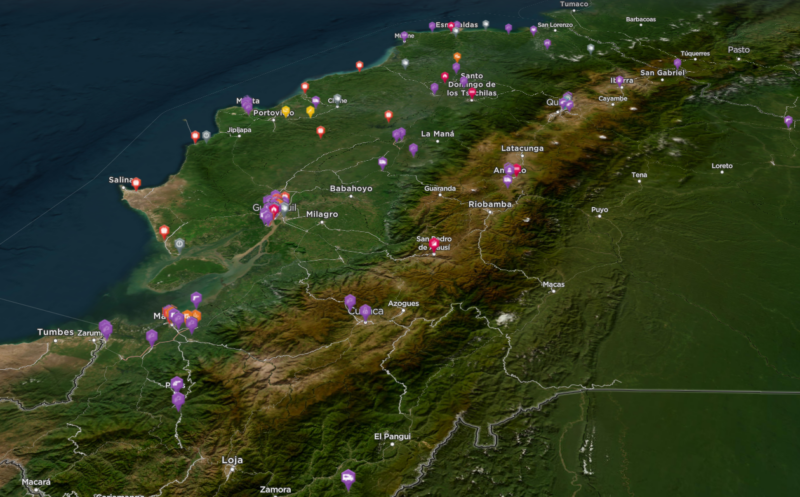
Image shows significant incidents reported in Ecuador in 2026 to date on the S7ONE platform.
General background:
Despite its previous reputation as one of the most peaceful countries in Latin America, Ecuador has seen a significant rise in gang-related violence since 2017. Although mostly concentrated in the coastal regions, with an estimated 80% of violence occurring in coastal provinces of Ecuador, gangs are increasing their reach throughout the country. This includes small neighborhoods to ports and cities, in addition to using the country’s prisons as operation centers. Gang membership estimates range from 15,000 to 60,000, and includes citizens from nearby Peru, Colombia and Venezuela.
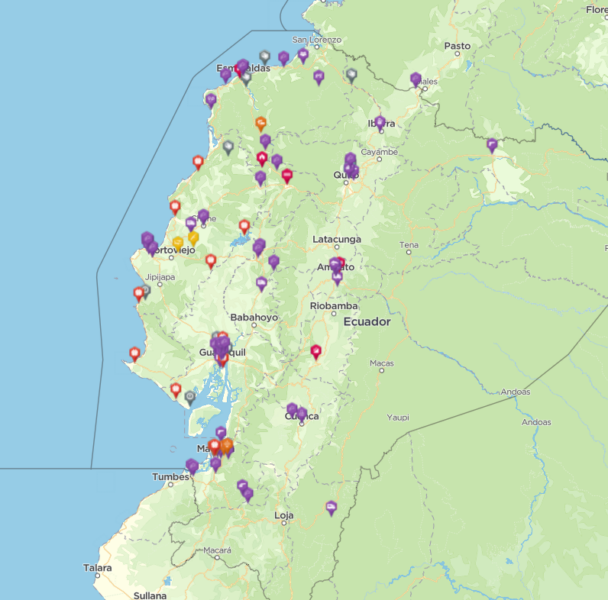
Related incidents recorded are generally clustered around areas such as Guayaquil and Manta due to their role as hubs for drugs trafficking.
As in other Latin American countries, criminal gangs in Ecuador are mostly motivated by economic opportunities. More specifically, Ecuadorian gang activity is intrinsically linked to drug-trafficking. Over the years, the port cities of Guayaquil and Manta have become major transit hubs for cocaine shipments originating from Colombia and Peru.
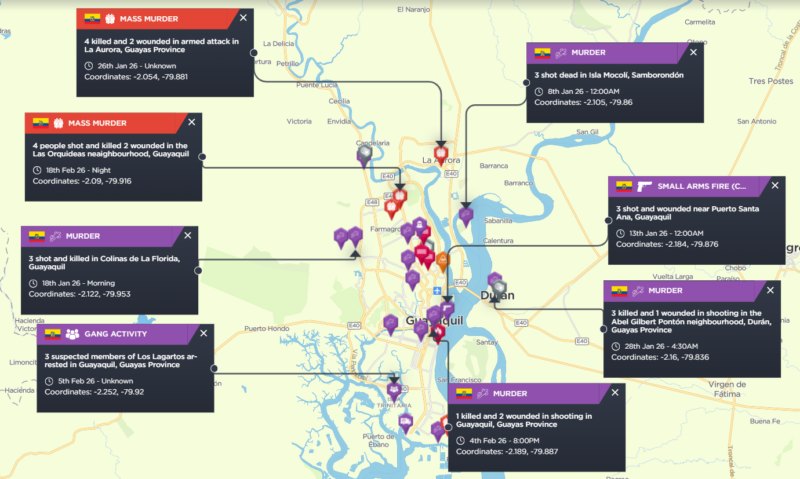
Image shows an example of significant incidents in Guayaquil, with many violent criminal incidents believed to be linked with organized crime.
Gangs have undermined stability in Ecuador through competing for access to ports and rivers. The use of violence to achieve this manifests in various forms, including the murder of judges, prison staff and regional leaders, as well as direct clashes with government forces. Administratively, gangs have infiltrated into local government and undermined institutions from within. Ecuadorians are increasingly living in divided communities led by rival groups. This is reflected in the levels of internal displacement driven by organized crime, with an estimated 125,000 people having relocated and 60% citing violence as the motivating factor. The security situation in Ecuador thus reflects the consequences of groups competing for territory in order to dominate illicit markets and maximize revenue.
National attempts to fight organized crime:
President Daniel Noboa’s anti-organized crime agenda has centered around a heavily militarized approach to directly confront criminal gangs. On several occasions, Noboa has declared states of emergency, and recently proclaimed an ‘internal armed conflict’ to involve the military more heavily in public security initiatives. In the longer-term this approach has been criticized as violence continues to soar in Ecuador. Homicides increased more than 36% during the first nine months of 2025 compared to the same timeframe in 2024, with the Minister of the Interior of Ecuador confirming that 84% of the overall 6,797 deaths were linked to gang activity. The reasons for this failure are multiple. Murder rates have increased as gang members compete to fill new power vacuums resulting from the targeting of middle and upper-level leadership. Ecuadorian criminal groups have also diversified their activities due to being targeted by the government. Rather than solely seeking to control territory, they increasingly turn to selling weapons, extortion tactics, engaging in illegal mining, kidnapping and human trafficking amongst others. Furthermore, despite the depth of gang infiltration across Ecuadorian society, the militarized response has left key issues such as tackling corruption insufficiently unaddressed. Gangs are continuing to evolve by forming new alliances, with Los Tiguerones groups in Guayaquil recently joining Los Choneros and Los Lobos. The US’ mission to support Ecuador’s fight against criminal gangs is thus preceded by a national attempt to address the groups which has further complicated the organized crime landscape.
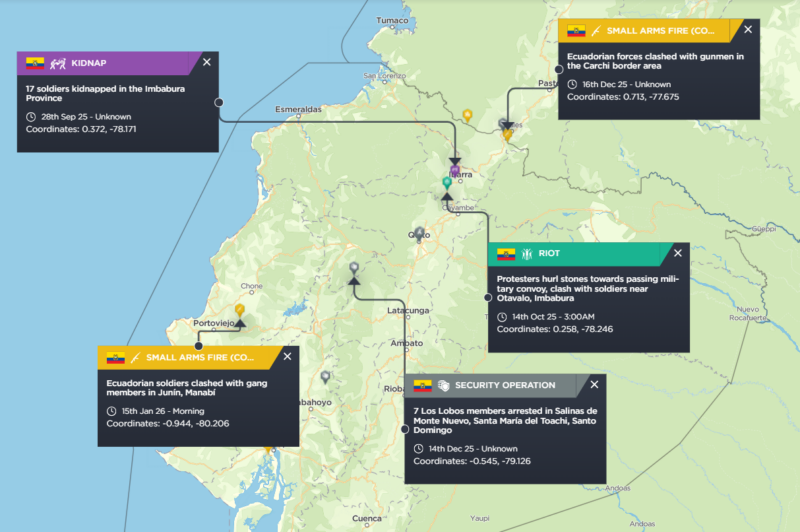
Image shows examples of military forces being involved in countering criminal gangs, with incidents often involving significant military operations.
US involvement:
One of the most prominent actors in the international fight against criminal groups in Ecuador is the United States. US involvement in Ecuador comes at a time when it is increasingly active in combatting organized crime and drug-trafficking in nearby Venezuela and other routes in Latin America. Whilst the capture of Nicolas Maduro reflected the US’ willingness to intervene militarily where there is a lack of a coherent regional strategy, Ecuador’s government under Noboa has historically aligned with the US and its security priorities in the fight against drug trafficking.
Previous US schemes were launched in 2024 to directly address Ecuadorian communities and enhance safety at the local level. This included increased police training through the Safe Communities scheme, in addition to Back to the Center, which focused on improving the safety of the capital, Quito. Since then, the US and Ecuador’s joint strategy has expanded into various spheres.
More recently, the US formalized its involvement in Ecuador’s fight against organized crime through diplomatic engagement. This included official visits and public commitments to cooperation. In 2025, Ecuador and the US signed a bilateral agreement to combat organized crime, allowing for the exchange of intelligence at a deeper level between the two countries. This will enhance their ability to mutually assess and share information regarding suspected criminals and shipments.
The US has financially confronted Ecuadorian organized criminal groups, extending the initial sanctions package introduced in 2024, which targeted entities and individuals linked to gang violence. The US’ commitments to intelligence sharing also apply to the financial sphere, with the Financial and Economic Analysis Unit (UAFE) in Ecuador and Financial Crimes Enforcement Network (FinCEN) in the US sharing information and technical support with each other.
In September 2025, the US classified two of the most prominent organized crime groups, Los Choneros and Los Lobos, as terrorist groups, creating a route towards wider financial measures, such as the blocking of assets. The move is in tandem with the US designating other criminal groups in the region, such as Tren de Aragua in Venezuela.
Judicial approaches have been expanded, with the US adopting an increasing role in the prosecution of gang members. In July 2025, the Ecuadorian government extradited the leader of Los Choneros on drugs charges, marking the first Ecuadorian citizen extradited from Ecuador to face justice in the United States. The US Department of State also offered rewards for information leading to the capture of other senior members of Los Choneros in late 2025 leading to 2026, as part of a wider attempt to increase cooperation with Ecuadorian authorities and enforce sentences, ultimately supporting the removal of senior crime figures from Ecuador.
US approaches to combat Ecuadorian groups are, like the Ecuadorian efforts, becoming militarized. This culminated in December 2025, as the US deployed troops to Manta air base in Ecuador for the first time since 2009 on a temporary mission. This action reflects the hope that their joint military efforts will be more effective at targeting and dismantling drug-trafficking routes than the Ecuadorian government acting in isolation.
The US government is also selling greater quantities of equipment to the Ecuadorian military to enhance the national effort. This included a $20 million funding package in 2025, covering a general security package and drone equipment for the Ecuadorean Navy.
Conclusion
Taken together, US involvement in Ecuador is multi-faceted, and has grown from community-targeted programs to a security-based and militarized approach to meet the growing challenge. The USA’s actions fit within a broader picture of the Trump administration’s direct confrontation with Latin American criminal gangs, given the continued targeting of narco-trafficking vessels in the Pacific. Furthermore, as the US continues to escalate its actions and rhetoric in countries such as Venezuela, this trend of direct interventionism seems only likely to continue. However, given Ecuador’s willingness under Noboa to directly co-operate with the US in its anti-drug trafficking operations, the likelihood of any direct military confrontation as occurred in Venezuela is minimized. The US has also created a blueprint for its operations in Ecuador, through selling equipment to the Ecuadorian military and commitments to intelligence-sharing, suggesting that the Ecuadorian government and the US are in alignment in their strategies going forwards.
In many ways, the US’ activities continue the militarized approach to countering organized crime adopted by Noboa, which has been criticized for intensifying criminal activity. Whether the US’ support changes the fortunes of this strategy remains to be seen, but the results thus far indicate that we should expect criminal gangs to splinter further and for violence to increase. Recent high-profile incidents linked to organized crime, such as the killing of 14 people in Los Ríos in October 2025, are also likely to strengthen US involvement and mean that Ecuador will retain its reputation as a Latin American violence hotspot going forwards.


