



Introduction
On the 9th of April 2025, the Trump administration announced a tariff increase of 125% from the existing 20% against China, leading to a massive tariff of 145% on Chinese products. China, on the other hand, responded with a tariff of 125% against the United States (US). What seemed like the start of a new trade war between the two countries brought significant concern in retail and supply chain sectors. Multiple analysts, businessmen and port officials have used sombre words to describe what could be the impact of such tariffs on the U.S. economy – some said it could be ‘devastating’, ‘widespread’, or ‘painful’.
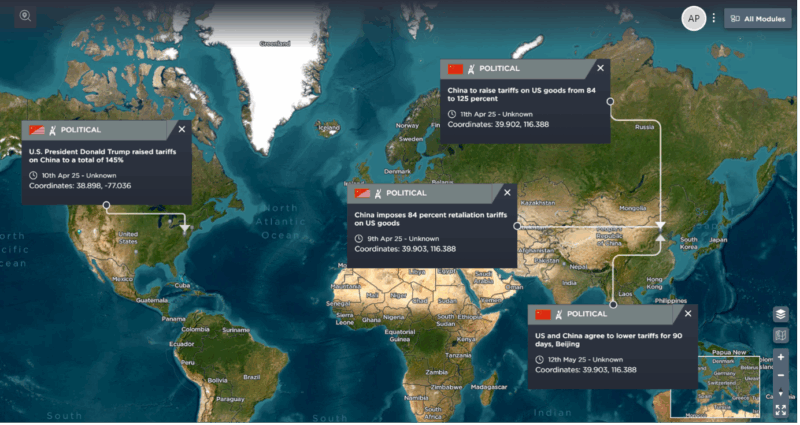
Figure 1. US-China tariffs (S7 ONE Threat Intelligence)
This report aims to shed light on the impact that US tariffs on China has had in the months of April and May 2025 at the five major US ports – Port of Los Angeles, Port of Long Beach, Port of New York/New Jersey, Port of Savannah, and Port of Houston – by looking at three metrics: container volume changes, supply chain disruptions and economic ripple effects. Furthermore, by analyzing the effects of past tariff increases, this report offers insights into what to expect if new tariffs are announced in the future. It should be noted that on the 12th of May 2025 the two countries agreed to a setback in Geneva, with the US slashing its tariffs to 30% while China dropping its tariffs to 10%. In June 2025, the U.S. raised the tariffs against China to 55%.
The report applies a Force Field Analysis to identify and evaluate the key drivers pushing towards or against a particular outcome. Each driver will be given a score (1 to 5) based on its intensity toward a positive or negative impact. The score will be given according to data as well as statements and opinions from experts found in the media. The impact of U.S. tariffs on China ranges from Severe Negative Impact to Minimal Impact.
The report concludes that U.S. ports did sustain a large drop in imports and that mitigating factors may not be enough to balance the negative impacts of high tariffs. Shipping costs, overdependence on Chinese imports, and supply chain rigidity outweigh positive forces.
Analysis
The five major U.S. ports in order of volume of twenty-foot equivalent units (TEUs) are Los Angeles, Long Beach, New York/New Jersey (NY/NJ), Savannah and Houston. Each port handles millions of containers every year, the majority of which originate from China.
In 2024 the Port of Los Angeles received 51% of total containerized imports from China; Long Beach 61%; New York/New Jersey 23%; Savannah 29%; and Houston 25%.
It is clear that the massive tariffs imposed on China must have had an impact on seaborne trade. According to the latest data, U.S. imports from China shrank by 28.5% in May 2025 compared to the year before, and by 20.8% from April 2025.The ports of Los Angeles and Long Beach experienced the most significant drop in volume, declining by 31.6 % and 29.9% respectively over April. The Port of NY/NJ saw a drop of 15.3% while the Port of Houston witnessed a milder 3.4% decrease. Interestingly, the Port of Savannah has not been affected yet and it actually received 2.2% more TEUs in May 2025 compared to May 2024. This is by virtue of post-COVID-19 investments in storage capacity at the port, which allowed ‘greater flexibility in timing supply chain movements,’ Georgia Ports Authority President and CEO Griff Lynch said. Other ports not considered in this analysis have experienced year-on-year significant drops, such as Tacoma (a dramatic -39.4%), Seattle (-17.3%) and Wilmington (-17.6%).
The key forces behind the impact of U.S. tariffs on China at U.S. ports can be divided into two groups according to whether these forces lead toward a severe impact or minimal impact. A score of 1 (weakest) to 5 (strongest) has been given to each driver.
Forces that drive toward severe impacts are the tariffs themselves, a limited ability to diversify supply chains, the historic dependence of West Coast ports on imports from China, and increased shipping costs. On the other hand, drivers that lead to minimal impact and adaptation are port investments, diversification of trade partners, stockpiling of goods by retailers/companies, and government-led mitigation measures.
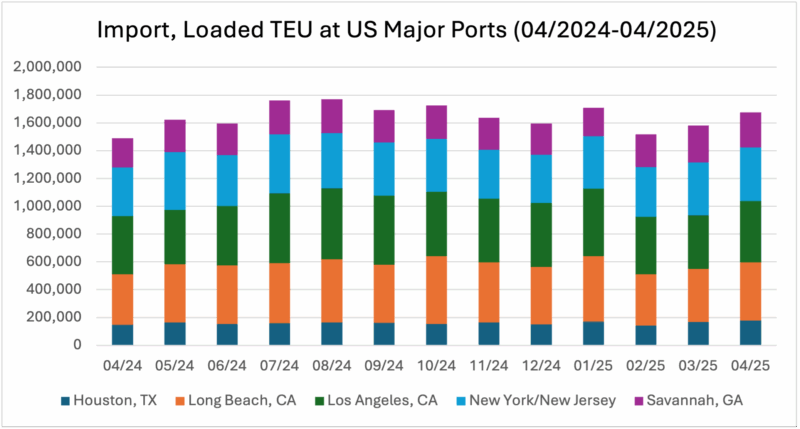

Starting from the negative impacts, the results are as follows:
• High tariffs reduce imports (5): as data shows, the U.S. tariffs on China have led to a general reduction of imports, thus impacting American ports. Los Angeles, Long Beach and NY/NY experienced a significant decrease in TEU volume coming from China, while Houston sustained a less relevant drop. The Port of Savannah has not been affected to date. Other U.S. ports witnessed major (Tacoma) or important (Seattle, Wilmington) reductions in containerised volume.
• Increased shipping costs and uncertainty (4): a natural consequence of tariffs is increased shipping costs including insurance, customs, and handling fees as well as transport itself, which rise to respond to the increase in the total landed cost of goods caused by the tariffs. Spot shipping rates between China and the U.S. for a forty-foot equivalent unit (FEU), another standard container along with TEU, rose by 9% for the East Coast and 16% for the West Coast in April. Tariffs also lead to uncertainty because changing rates provoke instability in schedules and trade volumes, thus creating fluctuating demand for port services that may push carriers to raise prices in order to manage risk and offset potential losses.
• West Coast dependence on China (4): Ports in the West Coast have historically been more dependent on imports from China given the shorter transit times across the Pacific Ocean. As a result, the ports of Los Angeles and Long Beach (as well as Tacoma) have been hit harder than ports in the Gulf Coast like Houston and in the East Coast like NY/NJ.
• Supply chain rigidity (3): Most U.S. ports have shown a lack of adaptability and, as shown, a strong dependence on Chinese imports. Infrastructure enhancements and modernization of terminals are needed to face shifting trade patterns.
Concerning drivers leading to positive impacts, the results are as follows:
• Port automation/efficiency (2): Investments in port infrastructure, such as terminals, quays, breakwaters, warehousing, etc., can alleviate the effect of tariffs. As shown, the Port of Savannah has managed to avoid their impact thanks to previous investments in storage capacity. Still, the score (2) remains low because enhancing infrastructure is not a panacea, albeit it can certainly help to mitigate the effects of tariffs in the short-term.
• Diversification of trade partners (3): As shown, several ports largely depend on imports from China because, in turn, many U.S. retailers are heavily reliant on Chinese goods for sourcing products. Retailers such as Home Depot, Target and Walmart sell a large quantity of Chinese goods, including apparel and footwear, and several CEOs warned the Trump administration of rising prices and empty shelves. Diversifying trade partners can be a solution to steer away from overdependence on China, thus mitigating the impact of tariffs on ports and the domestic economy. The increasing trade with Southeast Asian countries could be fostered further.
• Retailers adaptation (2): As shown, U.S. retailers alerted President Trump about potential inventory shortages and a surge in prices. Some officials have talked about ‘empty shelves’ for certain goods. These gloomy predictions and warnings indicate an over reliance on Chinese goods and a lack of flexibility and adaptation for U.S. retailers.
• Government mitigation (1): President Trump has started the trade war with China in February 2025 by increasing tariffs on imported Chinese goods by 10%. Tariffs against China reached their peak in April, amounting to 145%, before being cut to 30% on May 12. Today, tariffs on Chinese goods stand at 55%. The setback from the 145% tariffs was driven by economic unsustainability, as U.S. Treasury Secretary Bessent said, rather than the government’s will to de-escalation. Moreover, tariffs on Chinese goods at 55% still put pressure on ports and shipping, retailers, and consumers.
Results and conclusion
The aggregate scores for the negative forces total 16 (5+4+4+3) whilst for the positive forces total 8 (2+3+2+1). The net force is -8, thus negative forces outweigh positive by a factor of 2:1. This entails that negative forces dominate, indicating that the current tariff regime is putting a strain to trade volumes and port operations with visible ripple effects on retailers and, in turn, consumers. West Coast ports such as Los Angeles and Long Beach have suffered the most due to their heavy reliance to Chinese imports while East and Gulf Coast ports such as New York/New Jersey, Savannah and Houston have benefited more from diversification and adaptation.
Despite the massive U.S. tariffs against China at 145% was cut, current 55% tariffs on Chinese goods are likely to continue to distress supply chains at U.S. ports, especially in the West Coast. This report has shown, through a Force Field Analysis, that mitigating factors may not be enough to balance the negative impacts of high tariffs. Shipping costs, overdependence on Chinese imports, and supply chain rigidity outweigh positive forces.


