Summary
In June 2025, the Trump administration reinstated travel bans targeting 19 countries, reigniting debates over security, legality, and discrimination. While officials cite national security reasons, critics state that the approach is ineffective and counterproductive. The aftermath of previous travel bans demonstrate that the prohibitions provide little protection while harming alliances, inflaming radical narratives, and undermining civil liberties.
INTRODUCTION
On 4th June 2025, President Donald Trump issued Proclamation 10949 imposing total bans on travelers from 12 African and Middle Eastern countries. These include Afghanistan, Burma, Chad, Congo, Equatorial Guinea, Eritrea, Haiti, Iran, Libya, Somalia, Sudan, and Yemen. Partial restrictions were imposed on seven other countries, namely Burundi, Cuba, Laos, Sierra Leone, Togo, Turkmenistan, and Venezuela. The bans were primarily justified on the grounds of national security. The President highlighted a recent attack on Jewish community in Colorado that was allegedly committed by an Egyptian national. Egypt is not on the list of prohibited countries.
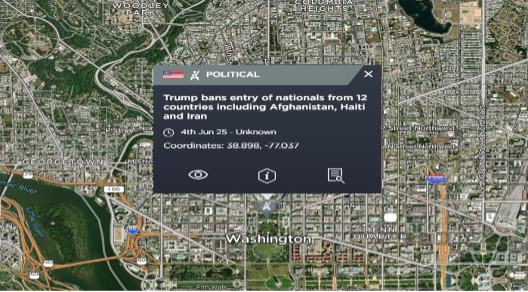
Figure 1: President Trump imposes travel bans on 12 African, Caribbean, and Middle Eastern states.
According to a Washington Post article [1], an internal State Department cable signed by Secretary of State Marco Rubio informed embassies in 36 other countries, including Angola, Egypt, Nigeria, Ethiopia, Syria, Tonga, Tuvalu, and several others from the Caribbean, Central Asia, and the Pacific, that the Trump administration would impose full or partial visa suspensions if they did not meet certain United States (US) regulations. These concerns included poor passport security, inadequate identity verification systems, lack of cooperation with deportations, and links to terrorism or anti-American activity. Despite the administration’s assertions that these measures are essential for maintaining national security, the tangible advantages continue to be debatable.
EFFECT OF THE BANS ON THE SECURITY LANDSCAPE
Despite being implemented with the intention of increasing homeland security by prohibiting the entry of individuals who might pose a terrorist threat, expert analysis and empirical data show that these kinds of nationality-based travel restrictions have little effect on domestic security. Most recent terrorist attacks on American soil have been carried out by either American citizens or foreign nationals from those nations not on the banned list, according to the FBI’s yearly threat assessment [3]. For instance, the March 2025 attack in Boulder, Colorado, involved a naturalized Egyptian national (a nation not included in the list of 19) proving that limiting entry from the nations banned by the Proclamation does not necessarily deter future acts of violence.
Domestically, debates concerning civil liberties, religious freedom, and the limits of executive power have been rekindled. Civil rights groups, such as the ACLU, the Brennan Centre for Justice, and the American-Arab Anti-Discrimination Committee (ADC), contend that the ban unfairly harms Muslims and are a thinly veiled replay of the 2017 “Muslim Ban,” which was legally disputed for years, despite the administration’s defense of the bans as being based on nationality rather than religion. Similar sentiments were echoed by the Brennan Center for Justice, calling the bans a “mass exclusion” driven by national security rhetoric.
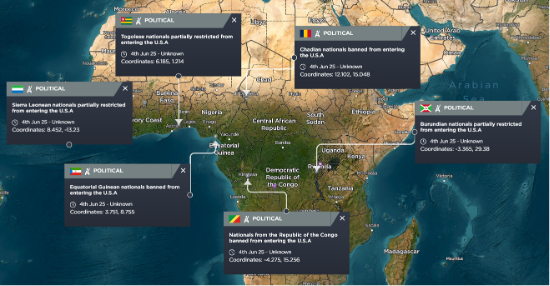
Figure 2: Some of the African countries whose citizens have been banned entry into the US.
The travel bans have also had negative impacts on collaboration between intelligence agencies and international diplomacy, two essential elements in counterterrorism policy. Several nations, most notably Chad and Sudan, voiced strong objection to the ban and suggested a re-evaluation of bilateral collaboration with the US . Chad expressed its displeasure with what it sees as an arbitrary and punitive policy by suspending the issuing of visas to US citizens. African Union officials have also denounced the strategy as discriminatory and counterproductive from a diplomatic standpoint.
WHAT NOW?
The 19 countries initially subject to these bans have a total population of more than 475 million people. At least 34,000 immigrant visas and more than 125,000 non-immigrant visas could potentially be blocked annually if citizens of these nations were prohibited from entering the US, according to data from a 2023 Department of Homeland Security report
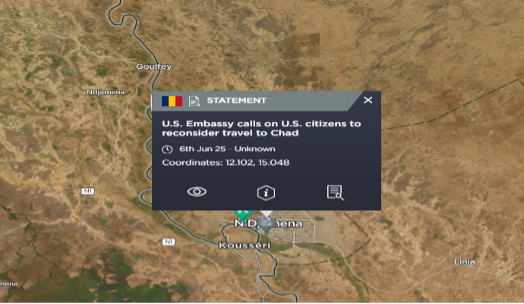
Figure 3: US reaction to Chad’s statements against the travel ban
The bans have strained relationships with countries crucial to intelligence cooperation and regional stability. For example, after Chad was included in an earlier iteration of the ban in 2017, the country temporarily halted security cooperation with US forces operating in the Sahel, resulting in the Trump administration reversing course and lifting the ban in April 2018. In 2025, a similar pattern is emerging with Sudan and Chad having reportedly limited information-sharing with US agencies, while other countries expressed their reservations about adhering with the proclamation.
The bans may also foster conditions that enable extremist groups to bolster propaganda. The Counter Extremism Project and SITE Intelligence Group have also identified cases in which jihadist organisations cited the initial 2017 and 2020 travel bans as evidence of American hostility towards Muslims. Although no recently published reports have confirmed the same effect in 2025, previous evidence strongly implies that a similar dynamic is likely to aris
For example, following the 2017 travel bans, ISIS-linked forums distributed recruitment messaging depicting the US as anti-Islamic, using the ban as justification. Amaq News Agency, ISIS’s media wing, reposted Western news coverage of protests and legal challenges to the ban, bolstering their claim that America was divided and weakened. They called for homegrown jihad, claiming that Muslims in America were under siege and needed to retaliate. ISIS supporters stated that the ban validated the message they had already been conveying to marginalised Muslims: assimilation in the West is impossible, and Muslims will never be regarded as equals in non-Muslim societies. This approach aligned with the group’s broader strategy of using American domestic issues affecting Muslims as both recruitment tools and ideological weapons. In 2025, due to American involvement in the war in the Middle East, similar sentiment may be raised by Islamist groups based in the Middle East and North Africa (MENA), as well as domestic Palestinian advocacy groups during pro-Palestinian protests.
CONCLUSION
Th e Trump-era travel restrictions’ restoration and planned expansion marks a significant shift in US immigration and national security policy, one with profound consequences. Though the prohibitions were designed to safeguard American borders and exert pressure on foreign governments to comply, they have not been very successful in tackling real security threats, many of which originate either within the country or through overlooked channels. They have also triggered constitutional and human rights challenges, strained diplomatic relations, and fuelled extremist propaganda. The bans also complement a robust domestic immigration enforcement policy, which includes increased ICE raids on illegal immigrants in several Americans cities. As the administration considers expanding the travel ban to up to 36 additional nations, legal experts, civil society organizations, and international partners have grown increasingly concerned.
References
[1] https://www.washingtonpost.com/national-security/2025/06/14/trump-travel-ban-expansion/?utm_
[2] https://www.fbi.gov/file-repository/counterterrorism/fbi-dhs-domestic-terrorism-strategic-report.pdf/view
[3] https://www.cato.org/testimony/restoring-integrity-security-visa-process
[4] https://www.fbi.gov/file-repository/counterterrorism/fbi-dhs-domestic-terrorism-strategic-report-2023.pdf/view