


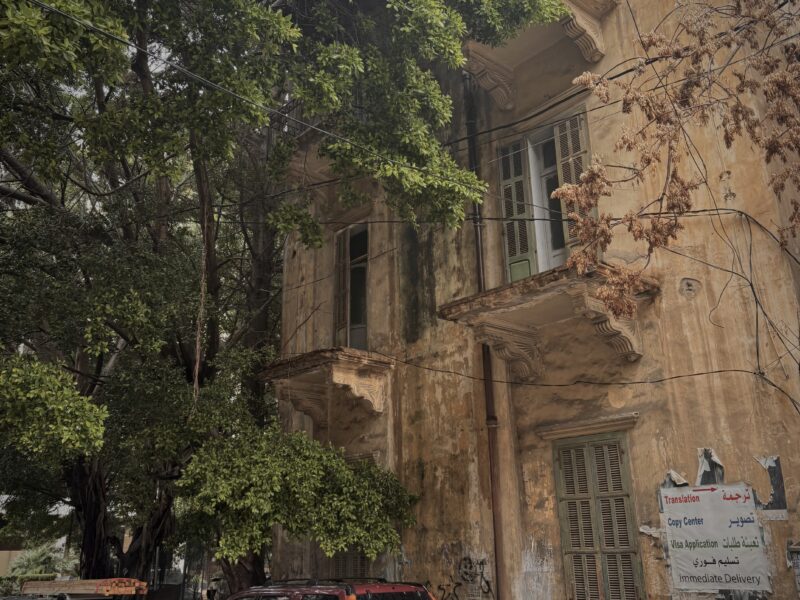
Not for the first time in its history, Lebanon has been through the wars over the last five years, both metaphorically and, sadly, literally. This most recent period of turbulence began in October 2019, amidst widespread public protests over a proposed ‘WhatsApp tax’. What initially appeared as opposition to a single policy quickly spiralled, materialising as a rejection of a political system long defined by corruptionand patronage. Protestors rallied against daily power cuts, mass youth unemployment, and an economy unable to deliver basic security to its citizens.
Just months later, the Covid-19 pandemic placed extraordinary strain on an already fragile healthcare system. Before any meaningful recovery could take shape, the catastrophic Port of Beirut explosion in August 2020 upended life in the capital, displacing some 300,000 residents, and causing over $3 billion in infrastructure damage. For many Lebanese, the blast reflected the country’s persistent blight of negligence, unchecked corruption, and a political class seemingly insulated from its own failures.
Not only has Lebanon had to contend with domestic issues, but also increased regional instability. The war in Gaza has sustained international scrutiny on Hezbollah , with retaliatory Israeli strikes devastating parts of southern Lebanon. International calls for the group’s disarmament are clear, yet such demands often underestimate the complexity of Lebanon’s domestic politics. The group’s role is not limited to thatof a militia, as Hezbollah is deeply embedded in the country’s political system, social services, and economic networks. Arbitrary disarmament deadlines do not take into account these intricacies.
Amidst all these challenges, perhaps the heaviest burden Lebanon carries today is economic. The country’s financial collapse has frozen over $90 billion of depositors’ funds within the banking system, savings that many Lebanese believed were secure, but now widely perceived as having been effectively expropriated by a political and banking elite protecting its own interests through a complex scheme of financial engineering. Yet the same elite have been protected from this fate, being able to bypass capital controls at the beginning of the crisis and stash funds safely abroad.
And yet, one the ground, Beirut remains resilient, as it always has been. The signs of societal turbulence are not as obvious as you might guess. Restaurants and bars remain open, only occasionally interrupted by brief power cuts to which no one seems to raise an eyebrow. The city’s roads remain busy, with a cacophony of horns acting as a backdrop to everyday life. Yet you cannot pay by card in Ubers, and are likely to receive change in a mix of US dollars and Lebanese pounds. The use of both appears so ingrained that the exchange rate is calculated instinctively by Beirut’s taxi drivers. Meanwhile, high-end boutiques remain open and prices for housing are surprisingly high. Services, and life, continue.
There is, however, a difference between turning a blind eye to difficulties, and refusing to pursue accountability. The topic on everyone’s lips remains the depositors’ losses. Over coffee in a stylish MarMikhael cafe, an investigative journalist, unable to access their life savings, recounted their efforts to support independent media in Lebanon, where press outlets have long been funded by political parties, sectarian groups, or wealthy patrons. This blurred line between journalism and advocacy inevitably constrains editorial independence, and the journalist’s refusal to adhere to these longstanding traditions of elite patronage of media outlets showed an undeniable commitment to accountability. Similarly, an expert in legal advocacy told us of the various challenges facing their organisation, even as their team worked late into the night pursuing cases few believe will ever reach a courtroom conclusion.
The challenge ahead lies in the extent to which Lebanon’s political and banking elites continue to shield one another from consequence. Reform efforts remain stalled, international assistance conditional, and meaningful restructuring delayed by competing interests. The outcome feared by many is that depositors and the state will absorb the losses, while those responsible evade accountability. As one source, seen to be among the few to have predicted the financial crash, put it: “the Lebanese take on capitalism is ‘privatise profits, socialise losses’.”
And yet, it would be a mistake to frame Lebanon solely through crisis. What emerged repeatedly during our visit was not despair, but determination. Our takeaways were clear; anywhere else in the world, these socioeconomic and geopolitical challenges would seem insurmountable; but in Lebanon, resilience is in the people’s DNA.
By Madeleine Glass, Sigma7 Business Intelligence


