


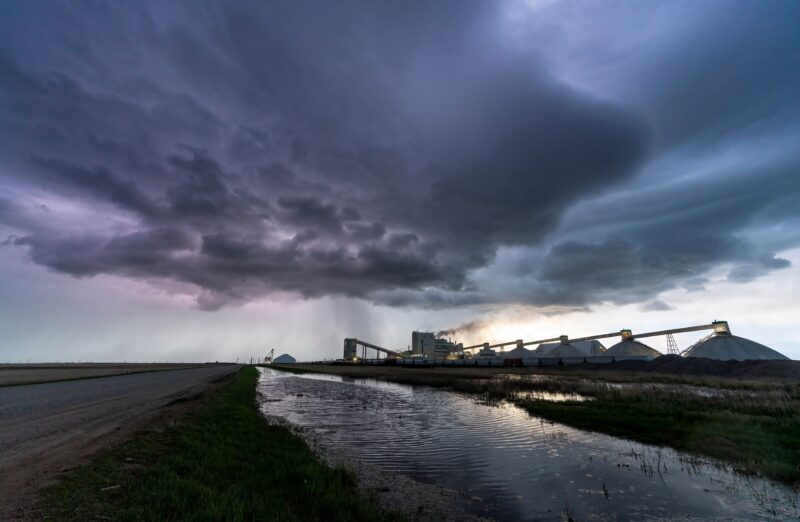
>>>>>>>>>>>>>>>As Aon notes in its Climate and Catastrophe Insight report, “severe convective storms (SCS) have surpassed tropical cyclones to become the costliest insured peril of the 21st century,” a shift driven by the sheer number and severity of thunderstorm, hail and tornado outbreaks reshaping global loss patterns.
Despite this reality, convective storms rarely command the boardroom focus reserved for hurricanes, earthquakes or other headline disasters. Their impacts often look localized and fleeting, yet they quietly erode margins through repeated property damage, operational disruption and rising insurance costs across large geographic footprints.
Industry loss data confirm the scale of the threat. Aon’s latest analysis indicates that severe convective storms generated about $61 billion in insured losses in 2025 alone, the third-highest annual total on record, a clear sign these events aren’t secondary risks anymore. Against this backdrop, companies that focus only on tropical cyclones may overlook a growing source of risk. Convective storms strike more frequently, affect more regions and carry significant financial consequences. The following analysis explains why convective storms deserve greater attention in corporate risk assessments. It also explores how their costs affect property, operations, insurance programs and enterprise resilience.
Reframing Convective Storms as a Major Corporate Risk
Historically, insurers classified severe convective storms as secondary perils, a category for hazards considered less threatening than hurricanes or earthquakes. Yet market evidence increasingly challenges that hierarchy. Moody’s states that secondary perils, including severe thunderstorms, “dominated the insured loss landscape in 2025,” underscoring how frequently recurring hazards have become primary drivers of loss.
Beyond shifting loss rankings, an economic policy magazine analysis shows that property damage from weather extremes in the United States has climbed by an average of about 6.5 percent per year since the mid-1990s, with thunderstorms, hail and tornadoes leading much of that growth. Treating convective storms as a lower-tier concern no longer fits the financial realities many industries face.
Here at Sigma7, we define severe convective storms as any rapid-onset system producing large hail, tornadoes or straight-line winds strong enough to compromise roofs, cladding or critical utilities. These hazards develop quickly, leave little time for defensive action and can hit multiple facilities across wide regions within hours.
Why the “secondary peril” label no longer fits
Aon’s 2026 analysis found that convective storms caused about $61 billion in insured losses in 2025, the third-highest total on record, highlighting their prominence in global catastrophe tallies.
Looking at the long-term trend explains why that status isn’t likely to fade. Aon’s research notes that “overall, exposures have grown at a combined rate of 8.6 percent per year.” The analysis also concludes that more than 80 percent of historical convective-storm loss growth stems from expanding exposures. Only a small share is attributed to other factors, including subtle climate signals.
Loss records from a federal climatology database tracking 400 weather and climate disasters since 1980 add more context: roughly $2.8 trillion in damages have accumulated, and thunderstorms, hail and tornadoes form a sizable share of that toll.
Frequent, geographically dispersed outbreaks magnify this burden for companies with diversified property portfolios. A single hurricane may dominate headlines, but dozens of smaller hail or wind events can dent the balance sheet throughout the year, repeatedly affecting plants, warehouses and distribution centers across multiple states. The result is a higher aggregate loss frequency that strains both budgeting and risk-transfer strategies.
Why limited media attention creates a planning gap
Media coverage usually focuses on large, singular catastrophes. This emphasis can skew internal risk perception, prompting boards and operating leaders to fixate on rare, dramatic events while underestimating the financial drag of recurring storm losses that never make national news. Because convective storms pass quickly, they’re often dismissed as routine even when claims data tell a different story.
Moreover, the speed at which these storms form and dissipate complicates executive awareness. Tornadoes or microbursts that damage one facility may be old news by the next morning, yet the resulting repair delays, supply-chain rerouting and insurance negotiations can last for months. Over time, mid-sized but frequent losses sap working capital, distract management and eat into insurance program limits.
As organizations confront these realities, understanding why convective-storm costs keep rising becomes essential. The next section explains why those costs continue to escalate even when annual storm counts don’t appear to skyrocket.
Tracing Why Storm Losses Keep Escalating
Meteorology alone can’t explain the upward trajectory in convective-storm losses. While storm frequency varies year to year, the financial impact reflects where assets sit, how they’re built and what it costs to restore them. For insurers, investors and boards, the resulting figures surface on balance sheets, not weather maps, making convective storms as much an economic issue as a climatological one.
How exposure growth amplifies each event
Shifts in population, industrial capacity and real-estate values mean that more property now sits directly in hail, tornado and straight-line wind corridors. State insurance filings show that a 2025 bulletin from Missouri’s insurance regulators reported carriers had already paid about $1.6 billion for weather-related claims by mid-year, with expectations of nearly $1.8 billion by year-end. The numbers show how even an inland state without hurricane exposure can face substantial storm payouts.
For asset-intensive sectors, the implications are pronounced. Manufacturing plants often rely on expansive, lightweight roofs that are vulnerable to hail damage. Logistics operators manage fleets and open-yard inventories spread across storm-prone regions. Energy and petrochemical facilities frequently concentrate high-value equipment outdoors. In these environments, windborne debris can trigger cascading outages and operational disruption.
As capital investments densify in these corridors, each storm inflicts larger absolute losses, straining both insurers and insureds.
How inflation and complexity increase claim severity
Rising repair costs compound the exposure problem. Moody’s attributes back-to-back United States convective-storm loss years exceeding $45 billion partly to climbing labor, materials and social-inflation pressures that push claim severity higher.
Operational complexity adds another layer of expense. Convective storms can hit multiple sites within the same organization over a single week, forcing finance and risk teams to coordinate damage assessments, vendor mobilization and claim documentation under tight deadlines. Each extra location introduces more invoices, lost-production calculations and policy endorsements to reconcile, driving substantial internal costs even before external recovery bills arrive.
Understanding how these structural and economic factors fuel loss growth sets the stage for examining where those costs ultimately land within the enterprise, from production schedules to financial statements.
Assessing How Costs Spread Across the Business
Storm damage rarely stays confined to the balance-sheet line labeled “property loss.” A federal climate assessment shows that extreme weather produced roughly $1 trillion in direct losses across the United States between 2017 and 2024, reflecting a broad spectrum of knock-on costs that ripple across entire enterprises and sectors.
How physical damage turns into operational disruption
Structural failures can halt production long after skies clear. After the May 2025 tornado in St. Louis, insurers processed nearly 9 000 claims and paid about $208 million within two months yet projected ultimate payouts of $330 million as repairs and business interruptions unfolded. Initial estimates often understate the real operational toll on affected facilities, fleets and distribution nodes.
Roof breaches can expose inventory to water damage. Utility disruptions may slow recovery, while blocked access routes can delay inbound materials and outbound shipments. Even localized disruptions can affect the broader network. Rerouting orders, reallocating production and repositioning labor can strain capacity and impact service performance across multiple locations.
Localized events can also generate cascading effects across multi-tier supply chains. When hail damages rooftop HVAC units at a contract manufacturer, downstream assemblers can face parts shortages within days, forcing expedited freight, production overtime or, in extreme cases, temporary shutdowns. These reactive measures often cost far more than the initial repairs.
How financial impacts extend beyond insured property loss
Property policies usually cover the most visible portion of storm-related expenses, but the protection gap between total economic loss and insured recovery remains wide. Aon’s 2025 catastrophe accounting tallied global economic losses at about $260 billion compared with $127 billion in insured payouts, leaving more than half of costs unfunded and on owners’ ledgers.
Business-interruption and extra-expense claims add more uncertainty. Without accurate pre-event valuations and real-time production tracking, firms may struggle to demonstrate earnings losses after an event. This can extend settlement timelines and delay recovery of funds. Indirect impacts can be equally significant. Reduced demand from storm-affected customers or postponed capital projects often fall outside policy coverage. However, they can still undermine financial performance and planning assumptions. Recognizing these hidden exposures is becoming increasingly important. As insurance markets tighten, more risk is shifting back to policyholders, a trend explored in the next section.
Understanding How Insurance Markets Are Repricing the Peril
Repeated convective-storm losses push insurers to recalibrate how they price, structure and allocate capacity. Global insured catastrophe losses have exceeded $100 billion for six consecutive years. As a result, underwriters have become increasingly sensitive to hail, tornado and straight-line wind volatility. For risk managers, these policy changes can shift more loss onto corporate balance sheets. This can occur even when headline premium increases appear modest.
How terms and retentions are becoming more restrictive
Insurers are responding to loss trends with higher wind and hail deductibles. Many are also introducing percentage-based retentions and tighter sublimits for roofs, outdoor equipment and business interruption coverage. Research linking weather-related property losses to a 6.5 percent annual increase helps explain this shift. Underwriters are increasingly seeking larger self-insured retentions to manage growing exposure.
Organizations with expansive real-estate footprints or older roof systems feel these changes most. A portfolio carrying multiple sites across the Midwest may now face 2 to 5 percent wind-and-hail deductibles on each location, effectively retaining millions of dollars of exposure per event, capital that has to be available on demand.
How claims and recovery expectations are changing
Stricter terms come with heightened scrutiny of documentation. Carriers increasingly expect granular proof of storm causation, line-item valuations and timely evidence of business-interruption impacts. Following the May 2025 St. Louis event, nearly 9 000 claims triggered more than $208 million in early payouts, with a projected ultimate loss of $330 million, numbers that underscore the need for disciplined loss verification as claim volumes rise.
Alternative risk-transfer mechanisms offer partial relief but don’t eliminate the need for fundamental resilience. Parametric covers, deductible buy-backs and industry-loss warranties can inject liquidity after large events, yet their triggers, pricing and capacity depend on hard evidence of risk-mitigation practices and reliable exposure data.
These market dynamics emphasize a broader point: insurance alone can’t carry the full weight of convective-storm risk. Businesses have to pair transfer strategies with proactive engineering, analytics and preparedness measures, a focus of the next section, which details how organizations can build a more defensible storm-resilience posture.
Building a More Defensible Storm Resilience Strategy
Insurance offers a financial backstop, but it doesn’t prevent damage or guarantee rapid recovery. Effective resilience demands an integrated approach that combines engineering upgrades, data-driven monitoring, continuity planning and disciplined claim readiness.
What stronger pre-loss preparation includes
Facility hardening remains the first line of defense. Once structural vulnerabilities are addressed, real-time situational awareness becomes critical. Organizations can overlay geospatial hail, lightning and wind-field data onto asset maps. This helps trigger tiered response protocols before storms arrive. Teams can secure rooftop equipment, pause high-risk outdoor work or relocate inventory ahead of impact. This foresight is especially valuable for logistics and manufacturing operations. Even brief disruptions can ripple through tightly connected supply chains.
What stronger post-loss recovery support requires
Rapid evidence capture determines how much of the recovery bill insurers ultimately fund. Records from Missouri’s 2025 storm season show timely documentation was pivotal to securing more than $200 million in early claim payments for a single tornado event, demonstrating the tangible benefit of organized post-event workflows.
Predefined inspection checklists, drone imaging protocols and accounting workstreams can accelerate damage valuation. They also help clarify causation, supporting smoother negotiations with adjusters. Forensic accounting then translates physical damage into defensible financial terms. Detailed tracking of lost-production hours, expedited freight and incremental labor costs ensures business-interruption submissions withstand carrier scrutiny. Integrated teams that include engineers, continuity planners and accountants reduce hand-off delays and align technical findings with policy language, shortening settlement timelines and improving cash-flow certainty.
These measures help reduce uninsured losses, accelerate recovery and improve access to insurance capacity. Convective storms remain a major source of volatility. Boards that treat resilience as an ongoing, data-driven process are better positioned to protect enterprise value and maintain stakeholder confidence.
Putting Convective Storm Risk Back on the Executive Agenda
Convective storms have shed their background-weather label. Loss records from insurers, regulators and federal databases tell a clear story. Convective storms now rival hurricanes in annual losses. They occur more frequently and affect regions from the Great Plains to the Mid-Atlantic. For companies with distributed assets, the implication is clear: sustained profitability and operational continuity increasingly hinge on disciplined storm resilience.
Recalibrating risk models, upgrading facilities, refining continuity plans and strengthening claim protocols all require cross-functional alignment and specialized expertise. The effort pays dividends in reduced volatility, stronger negotiating leverage with insurers and faster recovery when the next storm line forms.
Contact Sigma7 for a comprehensive risk assessment or to learn more about how our integrated risk engineering, threat intelligence and forensic accounting teams help organizations translate storm data into measurable resilience.


